
#40

I’ve written before about my wish for a “Figma for architecture”, a tool that would enable increasingly automated design as AI improves, and eventually absorb landscape architecture, interior design, and civil, structural, and MEP engineering too. If I had to guess, we’re less than three years away from fully automated schematic design, and less than five years away from fully automated working drawings. That’s big, and it will save a lot of time and money on soft costs
When I think about saving a lot of time and money on hard costs, my mind turns to 1) building code reforms, 2) more and better panelization, and 3) humanoid robots.My friend Conrad Speckert sent me this study that was conducted in 1995, prepared ahead of the 1997 edition of the Ontario Building Code. It’s wild to read, as these are the same issues we’re still discussing thirty years later! I’ll share a long excerpt from the Introduction because it’s so good:
“In Ontario, small-scale and mixed-use residential buildings have traditionally been built at two to three storeys in height. One of the consequences of continuing low-rise development in a rapidly growing city or town is ‘sprawl’, which often replaces valuable agricultural land and woodlots. At the same time, with development expanding into former open space, existing municipal infrastructure (sewers, water, gas, hydro, public transit) is not used to its full potential and expensive new infrastructure systems must be built.
It has been observed that residential development in urban areas in other parts of the world is traditionally six to eight storeys in height. In Ontario, impediments in the form of planning regulations, zoning by-laws, popular preconceptions, and Building Code requirements have discouraged such intensified developments. If small scale, taller residential and mixed-use buildings, at five and six storeys in height, could be encouraged by municipal initiatives and removal of impediments, it has been estimated that 80,000 new residential units could be built in Toronto without losing any open space or having to extend any services.”
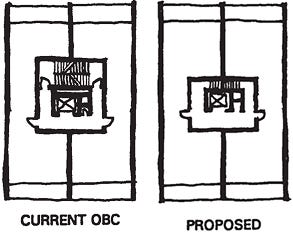
The study includes a series of proposals that would “1) [decrease] the construction cost for midrise residential and mixed-use buildings, 2) [increase] housing accommodation options in urban areas of Ontario, 3) [make] the involvement of smaller developers feasible, 4) [preserve and intensify] the existing urban fabric, 5) [utilize] the latent capacity of infrastructure systems".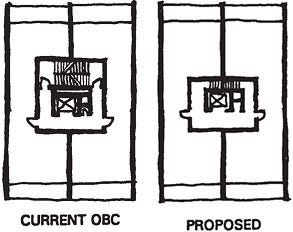
Again, this is the exact same conversation we’re still having thirty years later, including the same proposals I’ve discussed in this letter and at the Missing Middle Summit over the past few years.
This makes me feel both optimistic and pessimistic. Optimistic because it further confirms the fitness of these ideas, since they keep coming back. Pessimistic because we still haven’t seen them implemented.
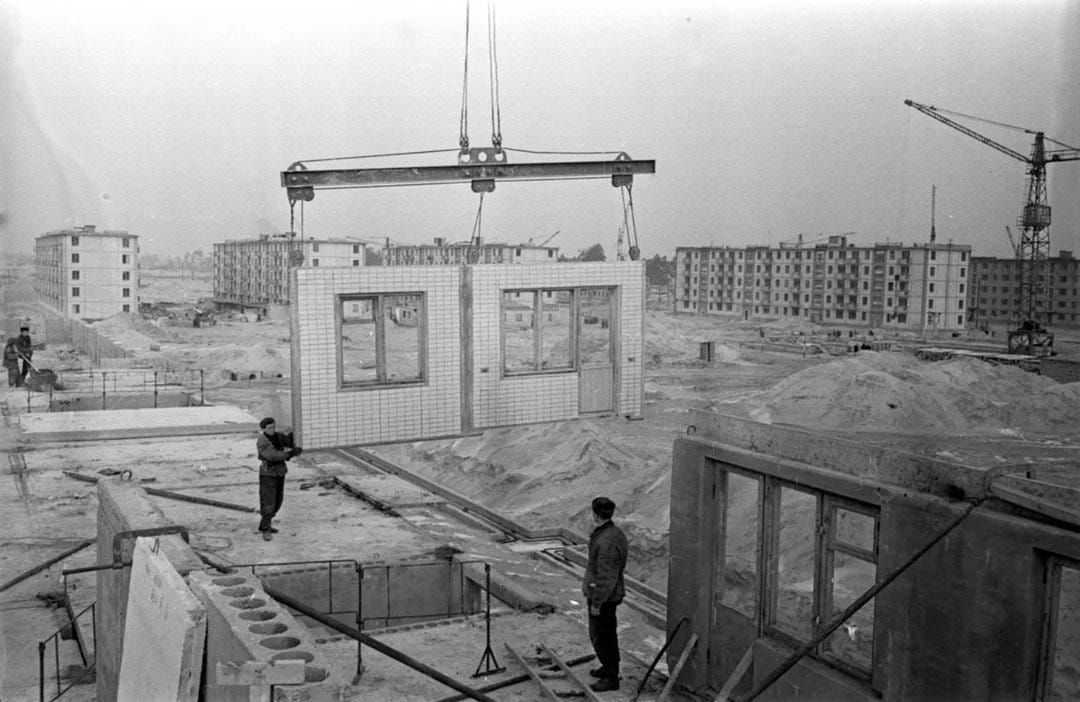
The Province is now conducting a new section-by-section review of the Ontario Building Code. They could do much worse than adopting these 30-year-old ideas.If modular construction is the dream that never quite delivers, panelization is its little brother that does. We’ve been building housing with panelized components for at least hundred years, all over the world.
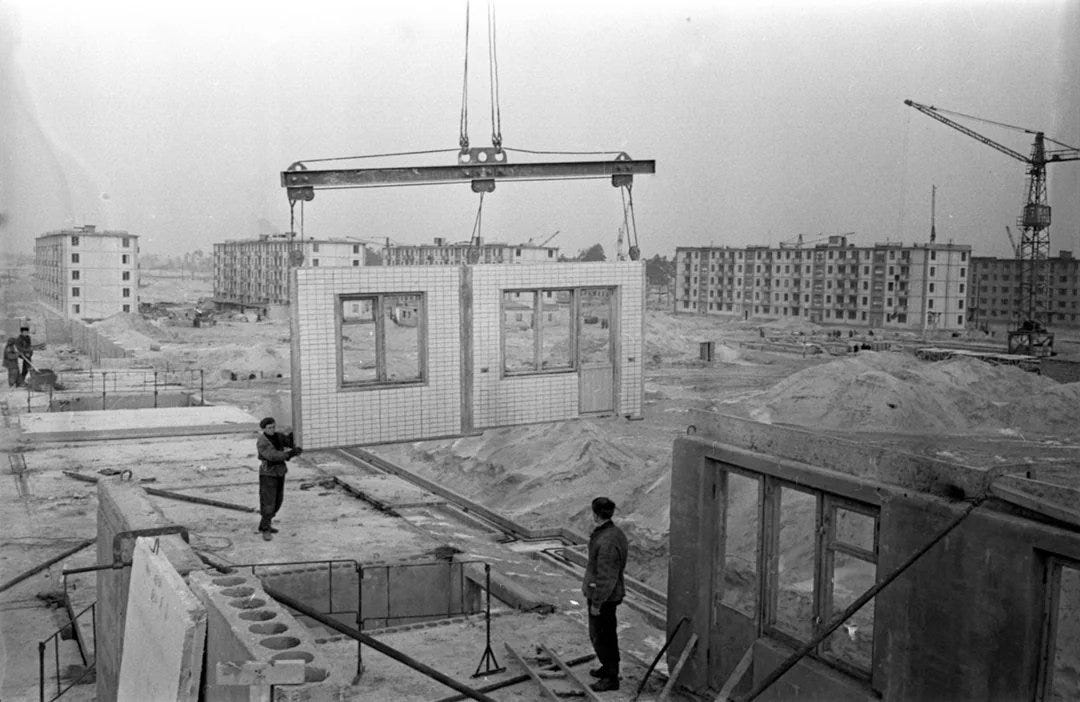
Modular construction suffers from a few persistent problems. It’s heavy, it’s hard and expensive to transport, it locks you into a narrow set of designs, and economies of scale get stunted by differences in building codes and zoning requirements between jurisdictions.
Panelization dodges most of that. You still get factory conditions, tighter tolerances, less waste, and faster schedules, but you ship flat instead of shipping air. Panels can slot into conventional on-site sequencing, so you can scale adoption without betting the whole job on a single manufacturer’s system. You also get to pick you battles. We like precast concrete floors and shafts, and cold-formed steal walls.
With better design coordination and maybe some advances in material science, there’s likely a lot more room for innovation and optimization here. We’re spending a lot of time digging into it.Humanoid robots are the third lever, and maybe the most interesting one. Progress on the hardware is moving fast, but as with self driving cars, hardware is rarely the real constraint. The big bottleneck, I think, will be training data. It’s the difference between a robot that can stand up and walk around in a demo video and a robot that can actually do work on a chaotic worksite without breaking things or hurting people.
Elon says he needs 10 billion miles for FSD. That’s roughly 200 million video hours. Masonry is far more complicated than driving. So how many hours of training data will we need, and where will they come from?
If we assume that FSD is 10x as complicated as masonry, and further assume that the nerds in Silicon Valley get us 100x improvements in sample efficiency, that still suggests something on the order of 20 million video hours. If egocentric video is the answer, it might take 20,000 masons one year to collect that much usable footage, or 40,000 masons six months, and so on. That’s a lot of coordination, but presumably worth the effort given the value created.
It’s an interesting question. Another interesting question is where the tradeoff occurs between panelization and humanoid robot labour once both technologies are a bit more mature, say in a decade.We’re almost sold out of Early Bird tickets for the Missing Middle Summit. If you haven’t yet, grab yours before the price hike!
For those of you haven’t attended in the past, this is the premier event for anyone currently developing, or looking to develop, missing middle housing. It’s also the best place for planners, designers, engineers, lenders, builders, and others to connect with those people.

re: "Elon says he needs 10 billion miles for FSD. That’s roughly 200 million video hours. Masonry is far more complicated than driving. So how many hours of training data will we need, and where will they come from?
"
The issue with self-driving vehicles is not so much the complexity, but the room for error multiplied against the magnitude potential harm. I think masonry can tolerate a much higher error rate.