#42

The 2026 Missing Middle Summit was a big success. Easily the best year yet.
The venue was a hit, and I think shortening the talks to 10 minutes made for punchier presentations while allowing us to cover more topics and hear from more speakers.
For the first time, we sold out roughly 48 hours before the event. Last year, we sold 41 tickets in the final 48 hours, so you can imagine how many calls and texts I was getting from people looking for a spare ticket.
I don’t love that people who wanted to attend weren’t able to, but I’m very happy with how popular the event has become.
My advice to anyone interested in attending next year is to buy your ticket early. Take advantage of the Early Bird pricing and you won’t have to worry about the date sneaking up on you, as it always does.
More importantly, I think the growth of the Summit reflects something real.
The missing middle housing development industry in Toronto, broadly defined, is maturing. Everyone is getting more dialed in, improving their designs and processes, and drawing more attention to the bottlenecks in policy, approvals, financing, servicing, construction, and operations.
And those bottlenecks are increasingly being taken seriously by City planning staff and other policymakers. They are not all being solved, obviously, and we still have a very long way to go. But the momentum is undeniable.Speaking of bottlenecks, one that continues to drive me crazy is the requirement for side yard setbacks even when you own and are developing the neighbouring lots.
I’ve written about this before, but I’ve now come up with a very targeted policy intervention that could be trivially implemented municipally and that I think makes a lot of sense.
In short: side yard setback requirements should be waived where a developer owns or otherwise controls two or more adjacent lots, but only along the shared internal lot lines.
I got Codex to spin up a quick one-page website breaking this down:partywallpermission.com
The basic idea is simple. If two or more adjacent lots are under common ownership, or are part of one coordinated development application, the City should permit a zero side yard setback / party wall condition between them, provided the buildings otherwise comply with the existing height, depth, and massing rules.
This would not eliminate setbacks against actual neighbours. It would not override Building Code, fire separation, servicing, drainage, or access requirements. It would certainly not allow someone to build onto someone else’s property.
It would just recognize that, when the same owner is developing multiple lots together, the shared lot lines between those lots should be allowed to function more like internal seams in the project.
Toronto already allows a limited version of this with semi-detached houseplexes. Two multi-unit buildings can share a wall along the internal lot line, but the permission is capped at four units per building. My proposal would extend the same basic party wall logic to sixplexes and small apartment buildings.
The upside is obvious. Useless interior-facing side yards become usable building area. Blank exterior side walls can become shared party walls. More of the already-permitted building envelope can be turned into homes. And small buildings can be arranged in a more efficient townhouse-like pattern, instead of being forced into awkward detached-building configurations with skinny gaps between them.
Matt Yglesias recently posted that “building setback rules may be the single most perverse idea we’ve adopted in this country—high compliance costs and no benefit whatsoever.” I think he’s right. We should be building more houses, multiplexes, and small apartment buildings in townhouse-like configurations with shared party walls.
If you think about the most beautiful low-rise residential neighbourhoods in the world, that’s probably what they look like.
My party wall permission proposal does not get us all the way there. But it does take us a step in the right direction, in true incrementalist Toronto fashion.I travelled to Mexico City with my wife last week. It was our first time.
Like most first-timers, we spent most of our time in “el pollo,” the part of town that includes Roma, Condesa, Juárez, Polanco, Chapultepec, parts of Coyoacán, and parts of Centro.
Roma Norte and Condesa in particular were among the nicest neighbourhoods I’ve ever visited. Beautiful architecture, nice walkable streets, a tonne of greenery, and some of the best food I’ve ever had in my life.
It was a great trip.
It also made me think more about what Toronto should be doing to nail urban design.
I made a joke at the Missing Middle Summit that Toronto housing policy needs to be both more libertarian and more communist. More libertarian in the sense of being more permissive, less prescriptive, and less rule-bound. More communist in the sense of having a more communal understanding of how we handle amenity space, garbage pickup, bicycle infrastructure, and trees.
The tree point in particular really hit home in CDMX.
As with the nicer parts of Manhattan and Brooklyn, which we also recently visited, the streets of Roma Norte are incredibly green, with world-class tree canopies, despite very few trees remaining on private property.
Developers cut those trees down to develop buildings. Then the city planted a bunch of new trees in the right-of-way.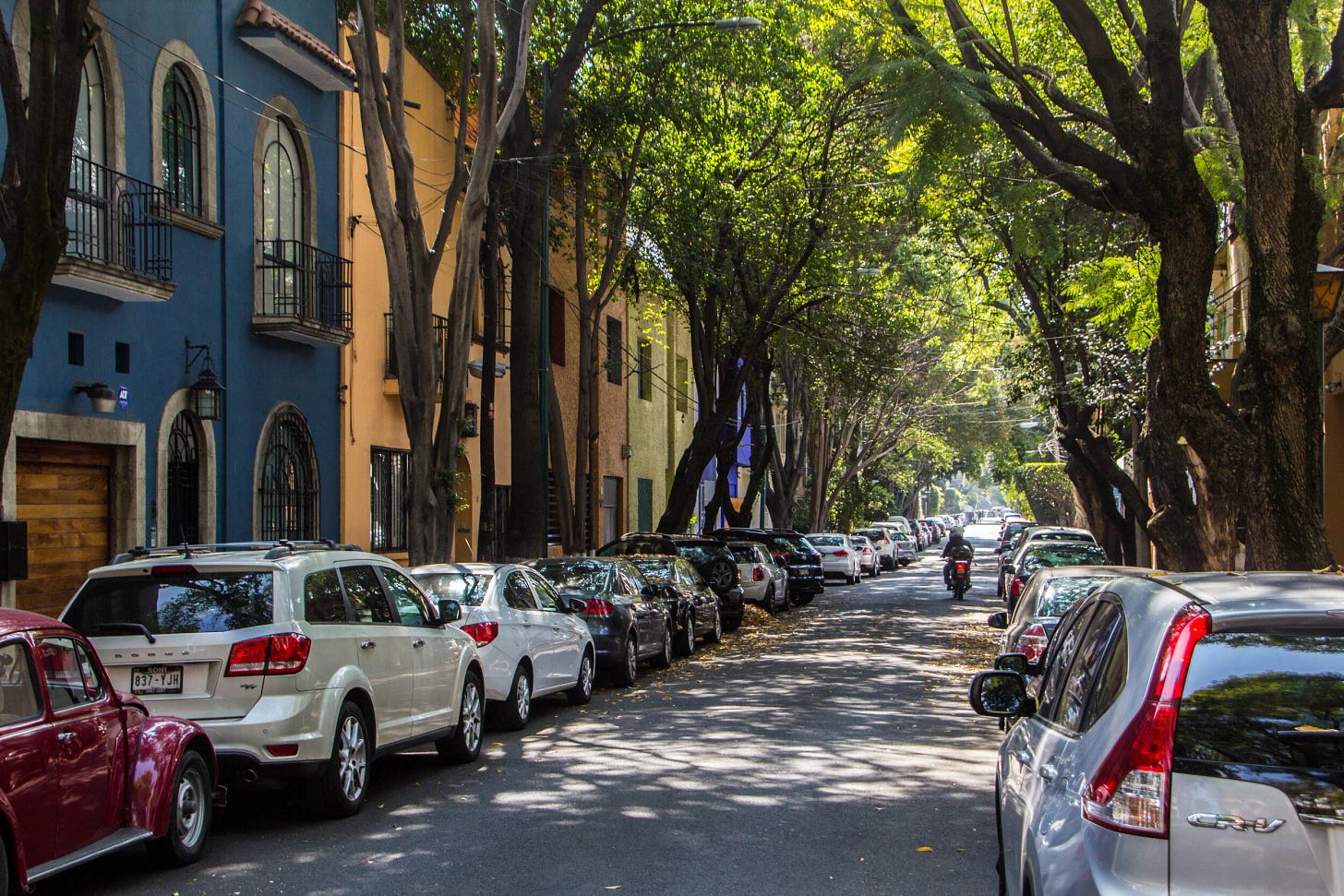
In Toronto, one of our perpetual frustrations when underwriting sites for acquisition is the uncertainty around whether larger by-law protected trees can be removed. City staff have told me that they’re struggling with a dual mandate from Council to both increase housing options in neighbourhoods (missing middle housing) and increase the tree canopy.
But this conflict is mostly self-imposed.
The solution is very obviously to allow the removal of trees that interfere with development on private property as-of-right, while planting far more street trees in the public right-of-way.
We should be less precious about trees on private property, especially when they stand in the way of new housing, and much more serious about building a continuous, high-quality, publicly managed urban canopy.
Given that most of Toronto’s streets and rights-of-way are oversized, there is plenty of opportunity to expand sidewalk widths and plant more street trees, especially where doing so does not interfere with infill development. That is where the canopy should go: along the streets, where everyone benefits from it, where it improves the public realm, and where it can be planned, maintained, and replaced properly over time.I also turned 40 last week.
This is the point where people often reflect back and provide 40 pieces of advice to younger guys. I generally don’t like giving advice, because so much is context-specific. What was right for me might not be right for you. Etc.
When younger guys ask me for advice, I almost always frame it as “this is what I would do” rather than “this is what you should do.”
This is also why I prefer reading biographies to business books. I don’t want an author to tell me what to do. I want to read about what great people throughout history did.
There are some exceptions though. In particular, these three:
1. Start a business
2. Get married
3. Start a family
And do those three things in whatever order makes sense for you.There’s some ongoing speculation as to whether material progress toward AGI raises or reduces interest rates.
On the “raises” side, the argument is straightforward. A scaled data centre buildout over many years will increase demand for capital. More chips, more servers, more land, more power, more transmission. If demand for capital goes up, so should the cost of capital.
On the “reduces” side, there are two arguments.
First, AI is a deflationary technology. If software can do more of what humans currently do, and if robots eventually let software act in the physical world, then many goods and services should become cheaper to produce. That could put downward pressure on nominal rates, especially if central banks are trying to keep inflation from undershooting their targets.
Second, and more interestingly, as AI displaces labour, people may seek out safer investments.
Caleb Maresca makes this case in a new paper titled AGI Could Lower Interest Rates.
The core idea is that, if AGI automates a lot of human labour, then labour income becomes less valuable, less secure, or disappears entirely for many people. And if those same people do not own much equity, they do not directly participate in the upside.
So you can end up in a strange world where the economy is growing much faster, but many households feel less financially secure. The gains accrue mostly to risky capital, while workers facing labour-income risk demand more safety.
That demand for safety can push down the risk-free rate, even while expected returns to risky capital go up.
In Maresca’s model, AGI gets us to a world where “the risk-free rate falls to near zero despite growth rising from 2% to 11%, and the equity premium expands from 6% to over 20%.”
In that world, you probably want to own claims on the upside: equities, real assets, scarce land, infrastructure, energy, and other assets that benefit from much higher productivity.
You probably do not want all of your wealth sitting in cash-like assets while the economy grows much faster around you.
Tyler Cowen has repeatedly returned to the question of what bond markets are telling us about AGI. One common interpretation is that, if bond markets believed AGI was imminent, long-term yields would already be rising.
Maresca explains why that might be wrong.