#39

Today is Toronto Standard’s second anniversary. Kris, Matt, and I started the company on January 1, 2024, after having worked on a few projects in the past, including 656 Annette and 3807-3829 Lake Shore, at opposite ends of the scale.
We started Toronto Standard to focus on development full-time under a unified brand, and to lean into the improved permissions we saw on the horizon for midrise development, including the City’s Major Streets study, new and expanded Avenues, and updated Midrise Building Design Guidelines.
We now have five new active projects, ranging from six to sixty units (not including the 490 units at Lake Shore), and we expect to hav over 100 of those units under construction in 2026. Our short term goal (1-2 years) is to reach a pace where we’re launching 200+ units’ worth of projects per year.
To make progress against that goal, we’ll have to keep getting better at what we do. I think that we’ve gotten very good at acquiring good sites at good prices, creatively evaluating highest and best use, and navigating entitlements and financings. There are a few things we’re going to start doing differently, however.
First, we’re going to stop taking on projects that require stacking policy exemptions and loopholes to pencil. Given the byzantine set of rules at the City, Province (OBC), and CMHC (MLI Select), it is often necessary, especially on smaller projects (<30 units), to take advantage of blind spots that exist in any expansive regulatory system. While knowledge of how to navigate these blind spots represents a real edge, complexity and risk compound as they stack. Practically speaking, this means we’ll focus more on projects over 30 or 40 units, where economies of scale start to show up. There’s a separate and very obvious point to be made about the desirability of simpler policy design, but I’ll save that for another time.
Second, we’re going to be a bit more conservative in our timeline underwriting, especially through entitlements. We might know that we can get through a zoning review and Committee of Adjustments process in three months, for example, but we should underwrite scenarios that include a deferral, and in some cases a TLAB appeal, to give a fuller outlook to ourselves and our partners. Practically speaking, this means adding a timeline contingency to our pro formas, in addition to the cost contingency we already include.
Third, we’re going to spend a bit more for better design consultants. Every dollar counts in development, especially at smaller scale, and that has sometimes lead us to retain lower-cost consultants who end up being harder to communicate with, harder to hold to account, and generally harder to work with. Among other things, this can slow the design and entitlement process, which in turn increases land loan servicing costs. It’s become clear that we don’t actually save money this way. The benefit of working across multiple projects, with multiple architects, planners, civil engineers, MEP engineers, structural engineers, and so on, is that we now have a large enough sample size to know who we like and who we don’t. We’re going to spend a bit more to work with people we like, who communicate well and move quickly.
These are all fairly minor changes, but taken together they’ll help us do our jobs better and deliver more projects. I hope to learn at least three new lessons like these per year. I expect that next year’s will have much more to do with construction. (In particular, I’d like to learn why some stucco-clad buildings look much better than others. At a first approximation, I think that Santa Barbara finish and arched windows help a lot. There’s much more to explore here.)
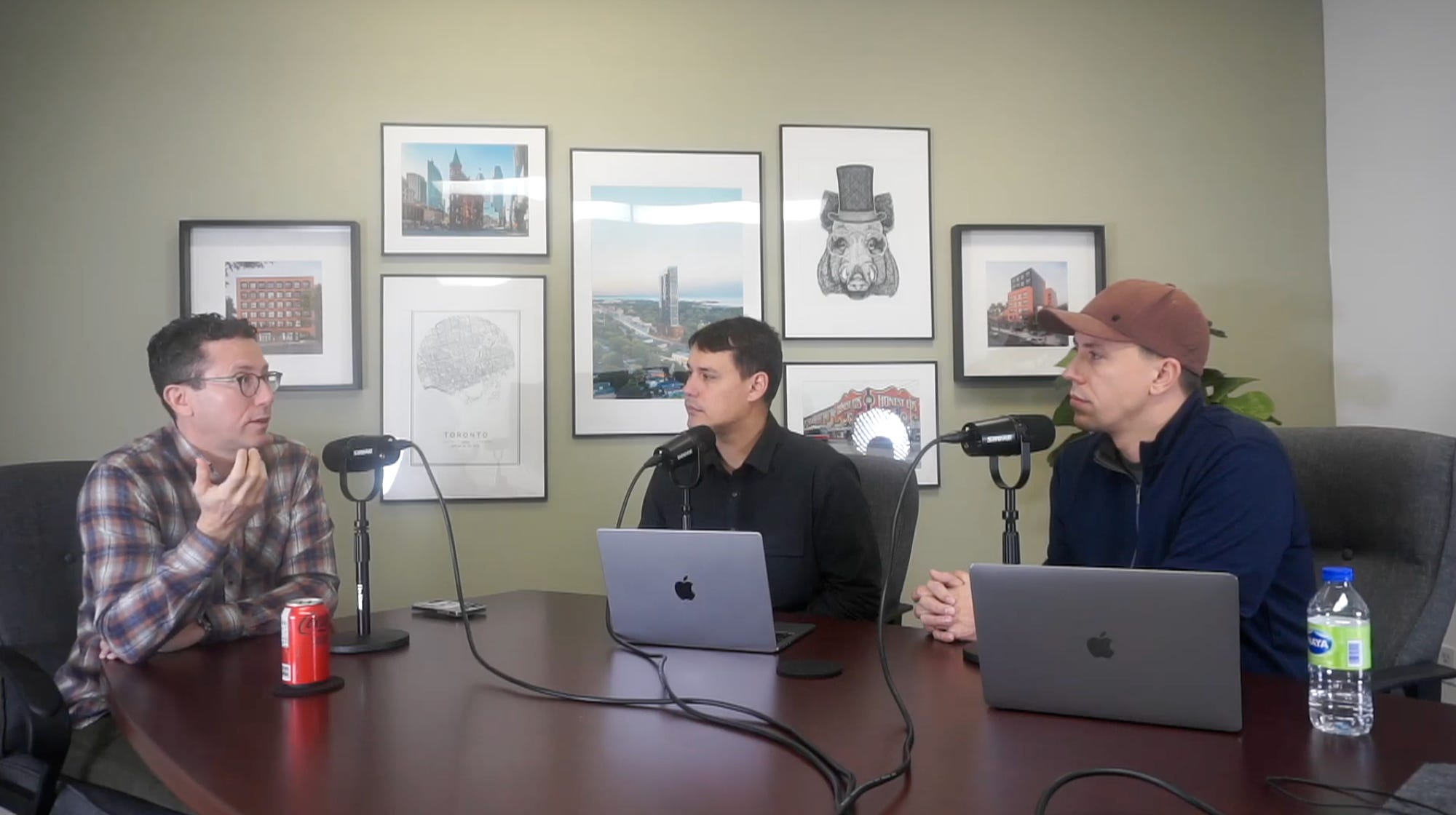
Our medium-term goal is to be Toronto’s most competent and disciplined rental developers, and I think that we’re well on our way.Matt and I have added video to our Hogtown podcast, with crucial help from Toronto Standard’s new marketing manager, Natasha. We’re still tweaking the setting, camera angle, lighting, and so on, but the most recent episode, featuring Build Canada founder Dan Debow, now looks like this:
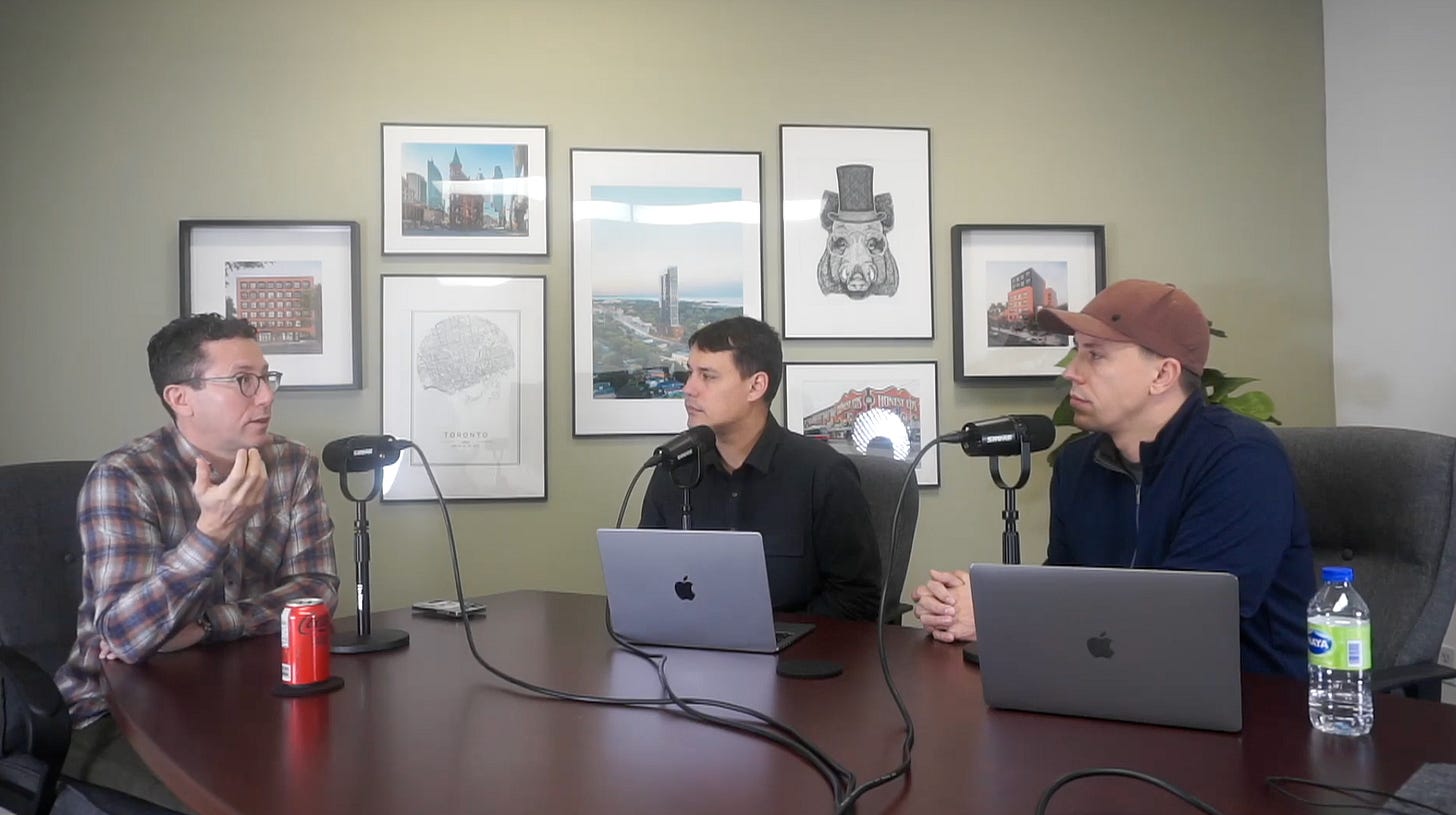
I think we could do more with lighting in particular to make it feel a bit more produced. And maybe some nicer chairs and mic stands. The podcast offers us a fun excuse to rant about the latest in housing policy, and it gives us a reason to have longer, deeper conversations with people we might otherwise only speal to briefly, if at all.
It took us something like thirty episodes to get the mics working properly, so I have no doubt that video will take a bit of iteration too. I’m encouraged by the fact that even podcast king Joe Rogan started with a truly amateur-hour setup, and still looked pretty-budget as late as episode 142!
I mentioned in last month’s letter that I’ve launched ticket sales for the 2026 Missing Middle Summit. This will be the event’s third year. In 2023, it took place a week after Council passed the Multiplex By-law. In 2024, it happened the day of the Council vote for the Major Streets policy. In 2025, it followed the release of the multiplex monitoring report.
You might be aware that the Province has directed the City to update its Official Plan and Zoning By-law for Major Transit Station Areas (MTSA), to allow four- to six-storey buildings on Neighbourhoods-designated land within these areas. My understanding is that these updates are expected to reach Council just a few weeks ahead of this year’s Missing Middle Summit. If that timing holds, it will likely be the most important upzoning of the year, and we’ll have a lot to discuss.
If you haven’t yet, take advantage of early bird pricing and grab a ticket.On the topic of the MTSA upzoning, I’ll end with a wish list.
The City should define three storeys as 12m and four storeys as 16m, to allow for tall ceilings, including in basements, which remain underrated. It should minimize front yard setback requirements and eliminate side yard setback requirements entirely. It should absolutely not impose any FSI or unit cap, and it should avoid encumbering sites in these areas with impractical landscaping and tree preservation requirements. It should also eliminate bicycle parking, bicycle maintenance, and amenity space requirements, and leave these to the market, much like car parking now is. With the political cover of Provincial direction, we have a real opportunity to properly urbanize large swathes of the city. We should take that opportunity seriously and do it well.
The Province should also reduce costly and unnecessary building code requirements at this scale, where they bite hardest. The jump from Part 9 to Part 3 of the OBC should be more gradual. Single egress permissions up to six storeys are obvious, as are permissions for European standard elevators. Doug Ford might be the worst-performing premier on housing, but with this policy, again, we have an opportunity to get it right. Half measures will not be sufficient.