#37

On the Tesla Q3 earnings call last week, Elon Musk said robotaxis would be operating in “eight to ten” metro areas and that safety drivers will be removed in Austin by the end of the year. He also said on a more recent podcast appearance that safety drivers will stick around for about three months in any newly launched metro area before being removed. At this pace, I think that we can expect to see full US coverage without safety drivers by the end of 2026. That would be a remarkable demonstration of Hemingway’s “gradually, then suddenly”.
We’ve been promised imminent autonomous taxi services since at least 2015. It now looks like we’re finally going to get it, quickly. Musk even tweeted that “Tesla autonomous driving might spread faster than any technology ever.” If it works well in Austin, it can work well in 10 metro areas. If it works well in 10 metro areas, it could work well in 100. And so on.
It’ll be interesting to see how it performs in snow over the next six months.If we want to see robotaxi service in Toronto, a few rules will have to change.
Federally, we’ll need an update to the Motor Vehicle Safety Act and the Motor Vehicle Safety Regulations to allow for Tesla’s next generation cybercabs, which won’t include steering wheels or pedals. Provincially, we’ll need to update the Highway Traffic Act to build on the current AV Pilot Program (in place since 2016) to allow for full commercial deployment. Municipally, we’ll have to update the Vehicle-for-Hire bylaw to eliminate driver requirements. Curb and priority access rules that currently benefit taxis will also have to be updated for robotaxis.
Can that happen within the next twelve months, when I expect the tech to be demonstrably ready? Given the many obvious benefits, we should hope so. Permitting ubiquitous robotaxi service would be the most meaningful thing all levels of government could do to reduce auto fatalities, fill gaps in TTC/GO network coverage (without adding fixed costs), let the City reclaim on-street parking spots for bike lanes, car lanes, patios, etc. (and eliminate many curb cuts), and enable midrise infill development on lots that can’t fit parking in neighbourhoods that aren’t yet sufficiently connected or walkable.Speaking of infill development, we’ve closed on property purchases for two new projects in the last few weeks.
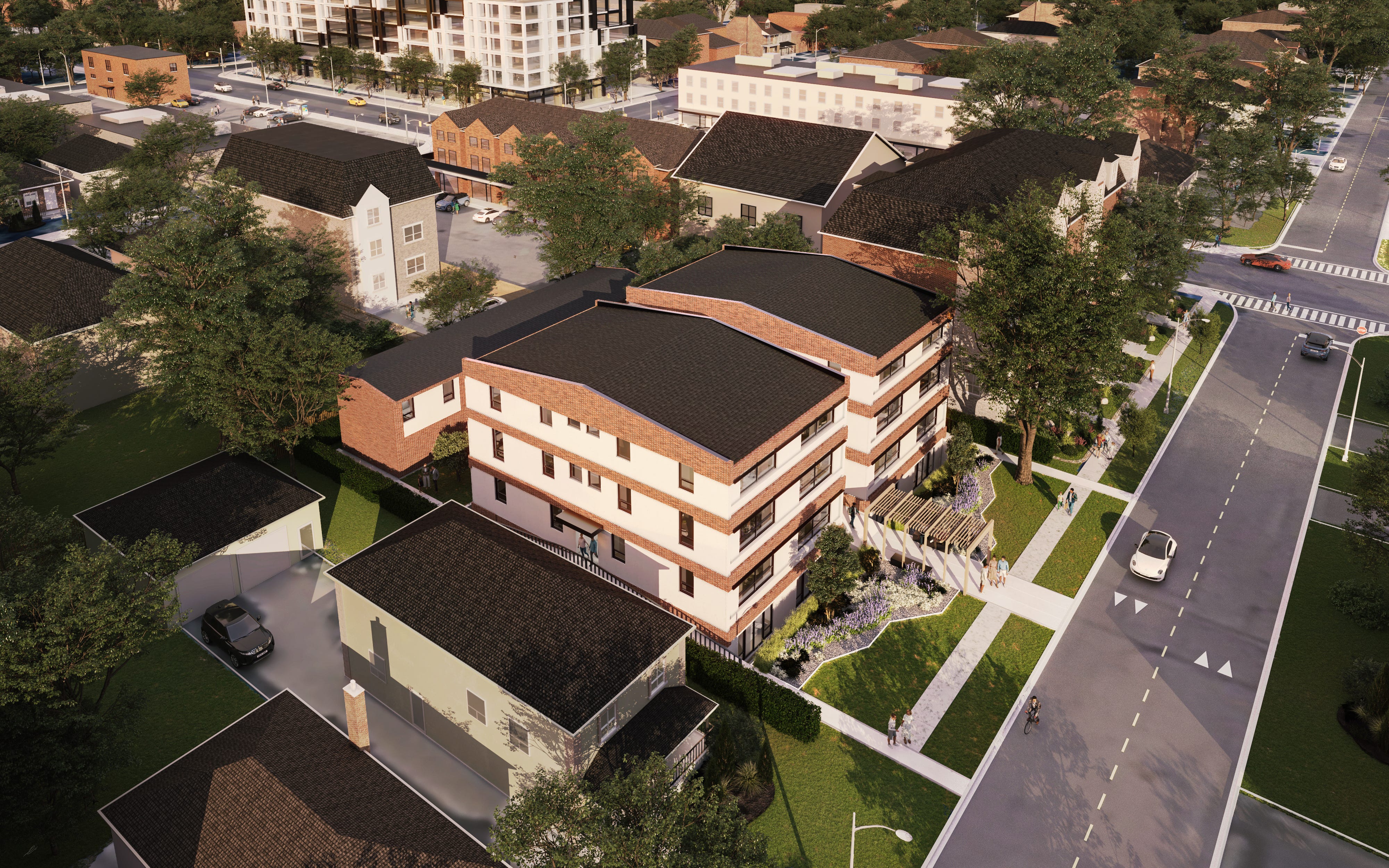
The first is in the Glencairn neighbourhood, where we plan to build 36 rental units across three lots, within a two-minute walk of Glencairn subway station (rendering below). The second is in the Junction, where we plan to renovate an old vacant Polish Baptist Church, including a two-storey addition, for six family-sized units within a ten-minute walk of both Dundas West subway station and Bloor UP Express station. (The latter remains totally underrated, and gets you to Union Station in eight minutes.)
These projects will include a total of zero new parking spots.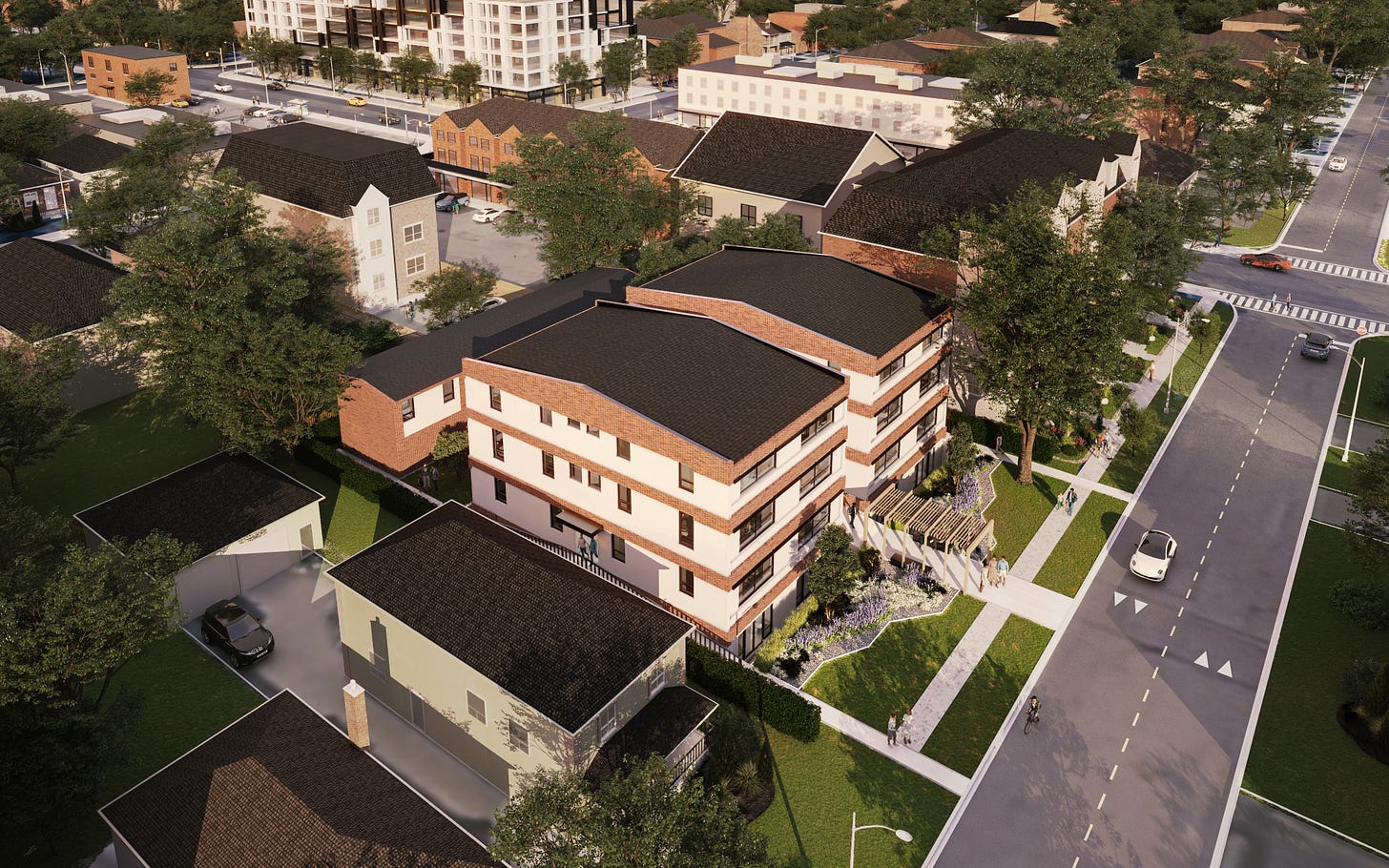
I think this is the best time in a long time, maybe since the MURB days of the 1970s, to be developing rental buildings in Toronto. Land prices are down from the peak, and so are construction costs, at the same time that planning permissions, particularly a the missing-middle-to-midrise scale, are slowly improving. We’ve already gotten the HST rebate on rental and expect some Development Charge relief soon. Finally, the collapse of the condo market is showing up as a collapse in total housing starts. If you project out to 2028+, very little new housing will be coming online in Toronto, around the same time OpenAI projects it will have developed an autonomous AI researcher, and about five years ahead of the best predictions for AGI.
I watched a great seminar with Stanford economics professor Chad Jones on how labour-replacing AI can and likely will work to boost wages. If you think about AI progress as being the process of automating more and more tasks, a lot of value will accrue to those remaining tasks that prove resistant to automation, and thus require human labour to be completed, because they unlock all the complementary tasks.
A simple example would be radiologists, who are even now using AI to help a lot with image processing, comparisons to priors, and first pass reports. They are however still required to be in the loop. Without a radiologist, all of the tasks completed by AI are not very useful. With the radiologist, you can now be something like 50 to 100 times more productive than you were a decade ago, because the human is making the final judgment and attaching accountability to the whole chain of work. Radiologist salaries have risen accordingly and are now in the mid 500,000 dollars per year range in the US.
The broader point is that AI does not just substitute for labour, it also increases the value of the labour that remains. The tasks that are hard to encode, that involve final responsibility, or that are tied to regulation and trust become bottlenecks. Whoever performs those tasks gets paid more in a high automation world.